Built fast and right, from the first version.
Cisely is the agentic product development platform for high-agency system thinkers — people out to challenge the status quo and build high-value solutions that last.
It is designed from the ground up to give you 100x leverage on the single greatest competitive advantage: your vision. It does so with a fully integrated context engineering stack that lets you harness AI as a force multiplier. You gain the operating velocity of an AI-native startup while keeping the operational control of a Fortune 500 enterprise, right from day one.
You no longer have to choose between fast and right. You can have both.
Already have an agent? Connect it to your model and keep building where you build today.
- Concise
- The business context — demand, and how you respond
- Precise
- The engineering context that answers it
- Answerable
- Every story links to the expectation it serves
right nowsomebody is asking for something ordinary
Each of these asks looks like an afternoon’s work for an AI coding agent. The real work is in everything the ask leaves out. Take “let customers delete their account” — how many systems do you think it touches?
Make your guessTwo graphs, one model
Your business is a graph. So is your software. They are the same graph.
A belief written twice in two documents can drift and nobody finds out. A belief that is a node can be pointed at — by a goal on one side and a strategy on the other — and whether they converge is a fact you can query. That is the whole reason this is a graph and not a folder of pages.
Concise
Business context
Who you serve, what they need, what you intend to do, and how you will measure whether it worked.
Edgesrooted inheld byservesmeasures
Mission and beliefs
Why the organisation exists, the future it is working toward, and the assumptions behind its goals and strategy — each marked assumed, observed or validated, so uncertainty stays visible.
RevealsGoals and strategies can point to the same belief, making alignment visible and traceable.
People and goals
Who you serve, the situations they act in, and what they are trying to achieve.
Expectations
The measurable outcome a stakeholder expects. Product work connects back to one of these expectations.
User stories
Product work with acceptance criteria, priority and a direct link to the expectation it serves.
RefusesA story cannot be committed without an active expectation or validated without a metric.
Precise
Engineering context
The systems, data, workflows, policies and interfaces that turn that intent into working software.
Edgessuppliesdeclaresemitsderives
System design
Actors, journeys, business processes, capabilities, systems and screens describe how the application should support the business.
RevealsIf a business process needs a capability no system provides, Cisely exposes the gap as work to do.
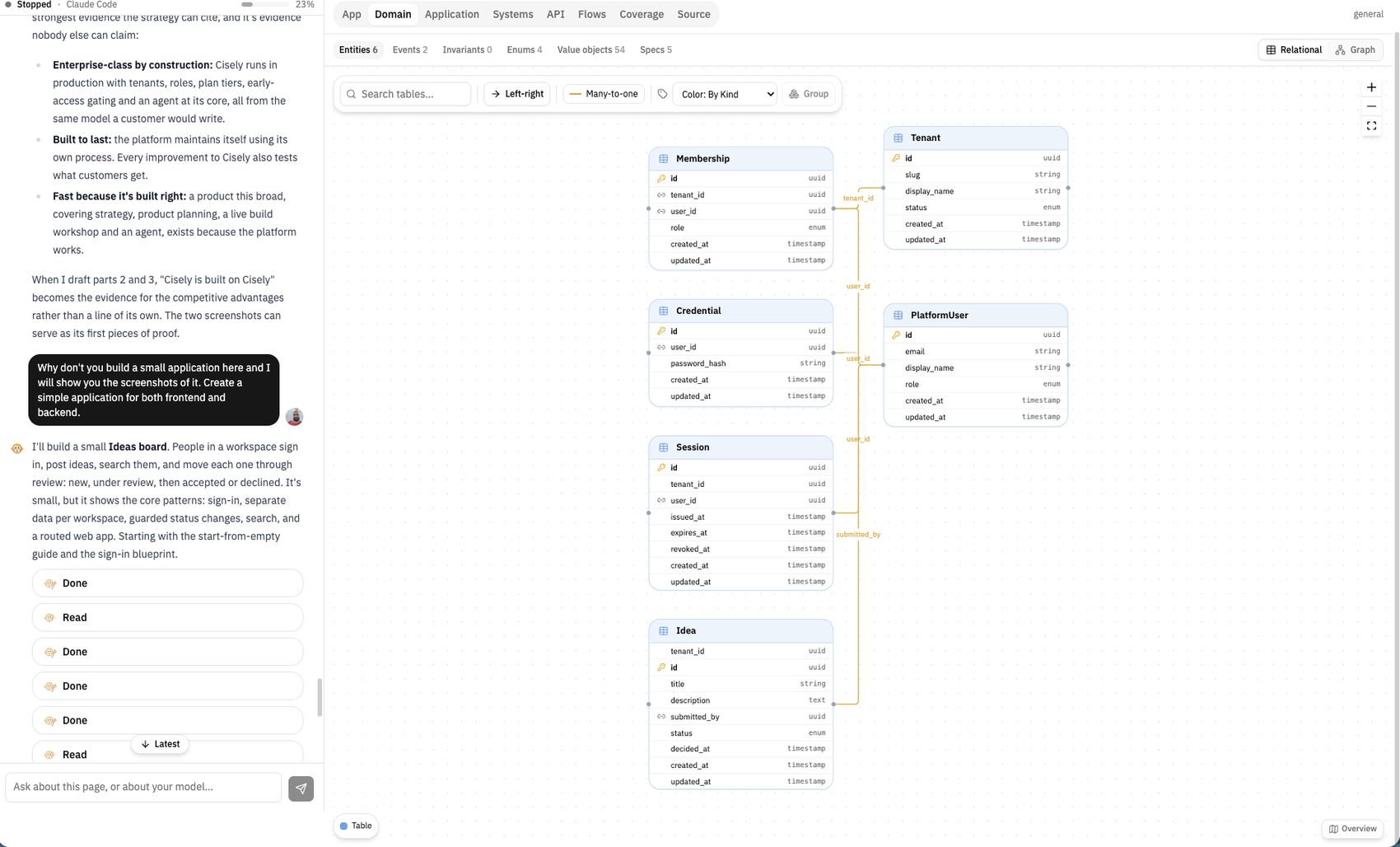
The domain
Entities, events, rules and policies define the business concepts the software must preserve.
The application
Commands, queries, workflows, routes and integrations define what the system can do and how it responds.
Running application
Cisely generates the backend, database migrations, API contracts and typed clients, then publishes them to a managed application environment.
A project uses only the business context your team has approved. You can trace a software capability back to the expectation it serves, or start with an expectation and see what was built for it.
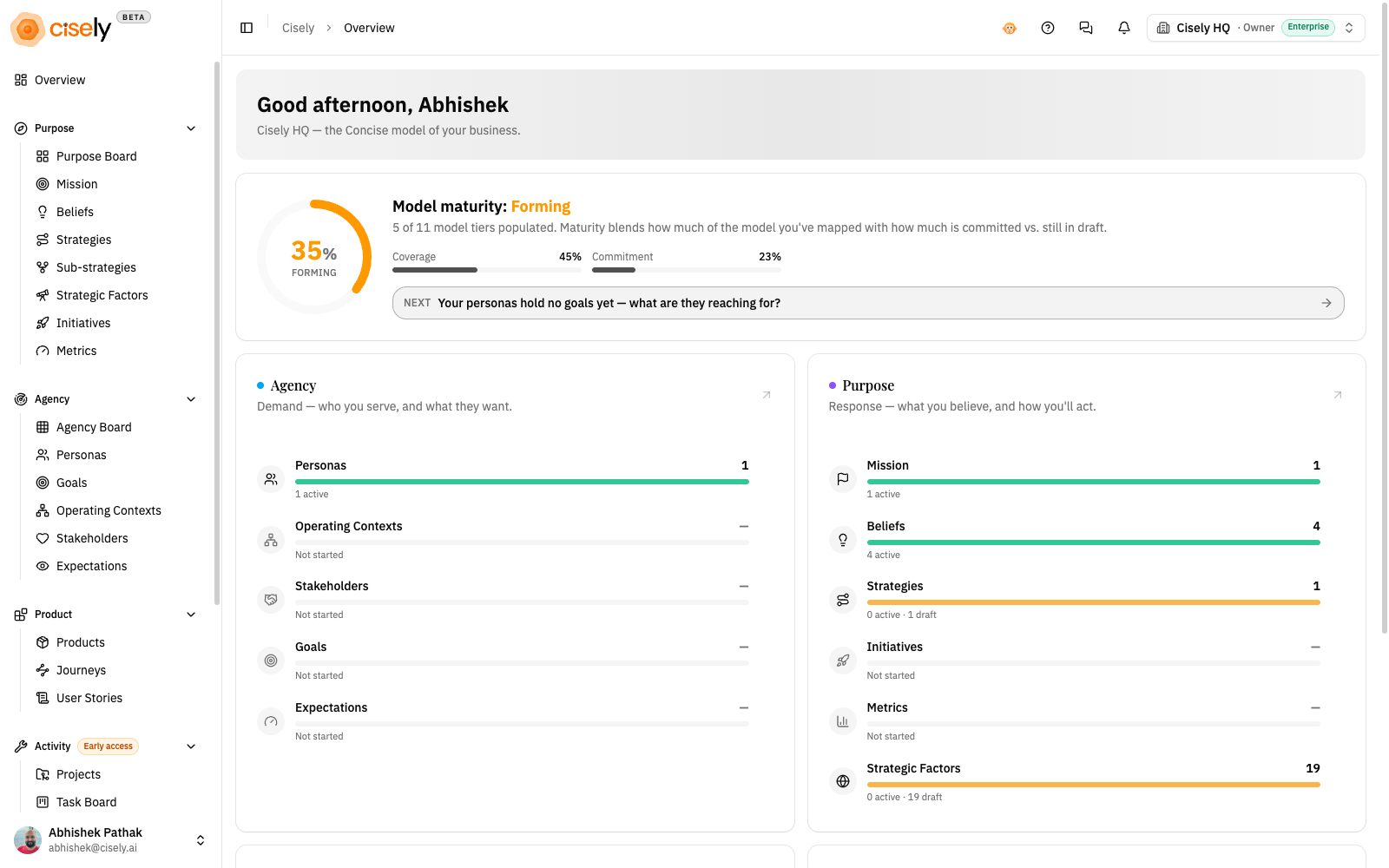
Concise — understand the business
Capture the context your team and agents need.
Tell Paroksh about the business and answer a few focused questions. They draft the mission, beliefs, strategy and personas; your team reviews and approves every part.
Define who you serve
Record personas, stakeholders, goals and the situations in which those goals matter.
Explain how the business responds
Connect mission, beliefs and strategy to initiatives, measurable hypotheses and outcome metrics.
Approve before it becomes context
AI-generated content remains a draft until a person reviews and activates it.
See missing connections
Cisely shows which goals and strategies share supporting beliefs, and which ones still lack evidence or rationale.
Precise — engineer the application
Turn approved intent into explicit engineering context.
Describe the system design, domain and application behaviour in the Vishwakarma language. Cisely validates the model and derives coordinated implementation assets from it.
Model the system plan
Define actors, journeys, business processes, capabilities, systems and screens in one connected design.
Make business rules explicit
Define entities, invariants, policies and events together with the reasons behind them.
Review each change
Build changes stay on a separate branch and can be reviewed before they reach the live application.
Publish a working application
Deploy the generated application to a managed instance with an API and an access-controlled MCP endpoint for agents.
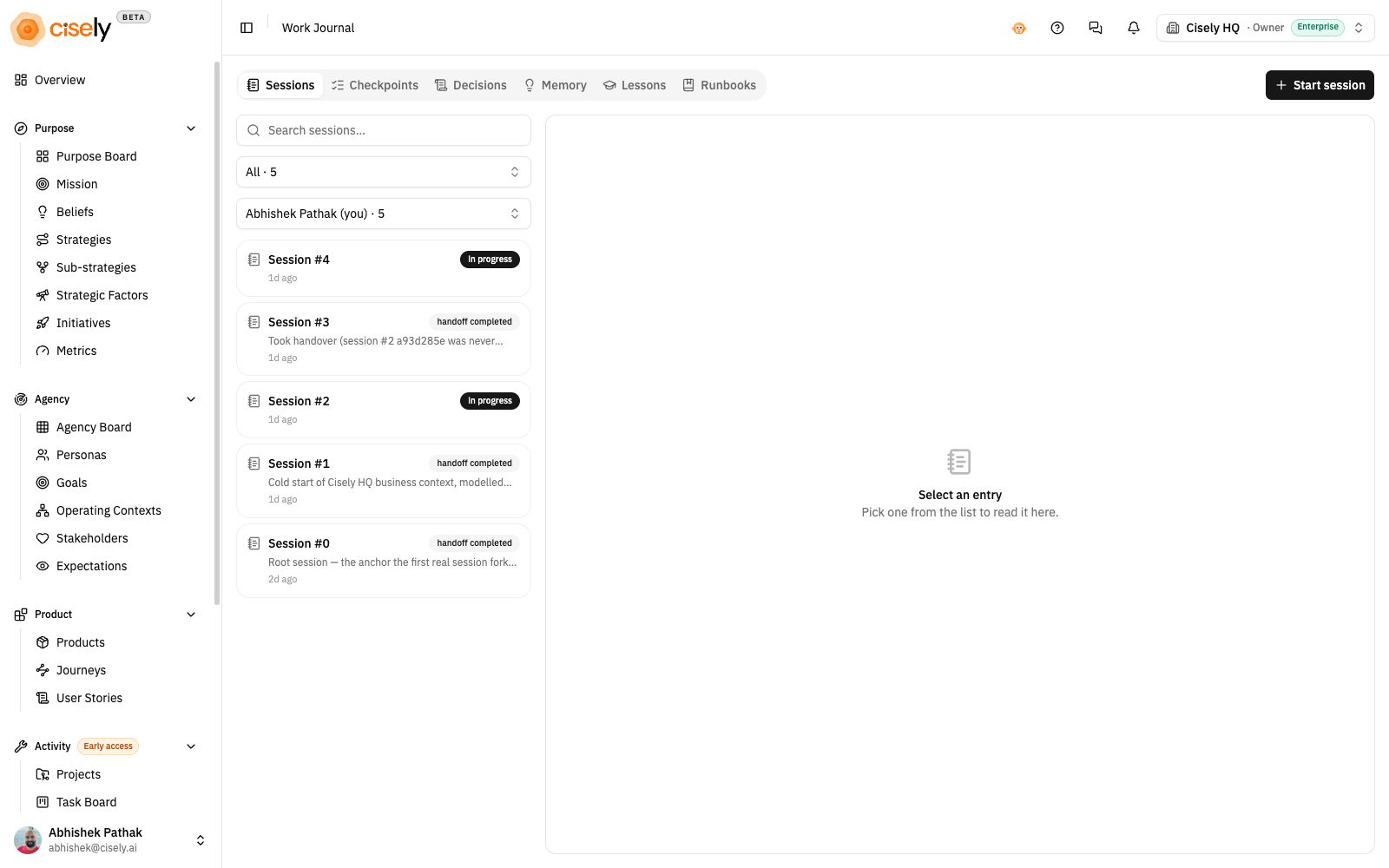
Keep delivery connected
Build against approved context, not a one-off prompt.
Each project reads the context your team has activated. Decisions, work and implementation stay linked to the business need they support.
Trace work in both directions
Start with a system capability and find the expectation and decisions behind it, or start with an expectation and see the work that serves it.
Keep the reasoning
Decisions remain visible as accepted, rejected or superseded, so later teams and agents can understand what changed and why.
Review before publishing
Inspect changes and previews before promoting them to the live application.
Pause for human decisions
When the model does not contain enough information, the agent stops with a clear question instead of inventing an answer.
What the model looks like
Who may act, and when it refuses, are lines in the file.
This is one command from a model running in production. Everything a reviewer would otherwise have to go looking for — the permission, the condition that refuses the write, the error it answers with — is declared here, in twenty lines, next to the thing it governs. Most days you will not open one of these. But this is the artefact your agent edits, and the backend, the schema and the API are derived from it.
Who may act is part of the operation
The policy travels with the command rather than sitting in a layer a different caller can go around. An agent given this operation inherits its rules — including one granted the operation later.
The refusal is declared, not discovered
The guard names the condition and the typed error it raises, so a client knows the refusal exists before it is written, and the case that should be rejected is as specified as the one that should work.
Every line here becomes an obligation
Each is a falsifiable statement about the running system, so the toolchain can count them and report how many have evidence behind them. This is what makes assurance possible rather than asserted.
command ActivateBelief {
  aggregate  Belief
  operation  update
  visibility public
  doc        "Put a drafted belief into force."
  errors     BeliefNotDraft

  // WHO MAY ACT. Not middleware someone remembered to add —
  // part of the command, and countable.
  policy [
    { leaf {
        name    "steward_only"
        expr    "caller.has_permission('context.belief.write')"
        message "Only a context steward may activate a belief."
    } }
  ]

  // WHEN IT REFUSES, and what it answers when it does.
  guard "status == 'DRAFT'"
        error BELIEF_NOT_DRAFT
        "Only a drafted belief can be activated."

  set status = expr "'ACTIVE'"

  id uuid required
}
The commitment ladder
A story that cannot name its reason does not move.
User stories are the only backlog item that must serve something. Each climbs a ladder that refuses shortcuts — so “why are we building this?” is answerable by construction, and “did it work?” can be asked of everything delivered.
As a persona, when situation, so that outcome.
From the story’s narratorThe only part you writeFrom the expectation it serves
| Move | Refused unless |
|---|---|
| Refine | there is a capability statement |
| Ready | it has a kind, acceptance criteria and a size |
| Commit | at least one expectation it serves is live |
| Deliver | — |
| Validate | a metric measures an expectation it serves, plus a written rationale |
The Overview scores how much of the model is filled in and how much is committed, and names the next best action. Unvalidated work is queryable rather than invisible.
Controls modelled from the start
Make operational requirements part of the application definition.
Declare security, reliability, commercial and agent-governance requirements alongside system behaviour, then generate their implementation with the rest of the application.
Security and tenancy
- Tenant isolation enforced by the database itself, with the tenant taken from the verified caller and never from the request
- Verified sessions, immediate sign-out, and no trust in client-supplied identity
- Authorisation declared per operation — simple roles, relationship-based permissions, or an external engine
- Cross-tenant operations explicit and reviewable; impersonation keeps the original actor for audit
Reliability
- Guarded state changes: the check and the write happen together, and a stale request is refused rather than overwriting a decision
- Events written in the same transaction as the change that caused them
- Reactions that retry with backoff and park persistent failures for review
- Multi-step workflows that commit or fail as one, with typed business errors
Commercial and operable
- Plan tiers, entitlements and pricing models the application enforces
- Per-tenant quotas at the edge, and per-tenant credentials for outside services
- Processes that scale independently — API on request load, workers on queue depth
- Traces, metrics and structured logs at every operation, attributed to the caller
Ready for agents
- Any operation can be offered to an AI agent as a tool
- Human sign-off required by risk level, including two-person approval
- What agents send and receive can be inspected and redacted
- The audit trail records which agent acted, and on whose behalf
Questions
The ones worth asking before you sign up.
Do I have to read generated code to stay in control?
No. You direct and judge; the agent builds. The Workshop gives you nine lenses on one model — the running app, domain, application, systems, API, flows, coverage and assurance — and Source is there when you want it, not because you need it.
Is this a code generator?
It generates a backend, a schema and its migrations, an API and its contracts, and typed clients — but that is the last stage, not the product. The point is that what it generates is derived from the same model your mission, expectations and strategy live in, so the software cannot drift from what it was for.
What happens when I change my mind?
Change the model and everything derived from it follows. A rename is made once. Schema changes are derived by comparing the model with the database rather than hand-written, and API contracts stay compatible with clients already deployed.
Can I take my application elsewhere?
What Cisely produces is an ordinary production application — a backend, a database, an API, typed clients and a React web app — and the Source tab shows all of it. Hand-written code exists only in declared, countable places.
Who is this for?
People who hold a clear vision and want to direct it themselves, whether that is a founder turning a conviction into a company or an architect inside a large organisation who can see the whole system before it exists. It is not for handing over the vision and hoping.
How finished is it?
Cisely is built in Cisely — its own purpose, strategy, product model and the software behind it all live in the substrate. That is the only honest test of a platform like this, and it means we meet whatever does not work before you do. It also keeps the loop back short: an agent that hits a wall can file a support ticket itself, structured as the gap it hit — what it expected, what happened, and what that blocked — so a problem reaches us without waiting for somebody to notice and write an email.
Get started
Model the business. Then build the thing that keeps its promises.
Start with your mission and let it reach all the way to a running application — or start from a reference implementation and work backwards. Both take an afternoon.
Publishing to your own live instance is available by plan.